P2P Sharing means share workspaces instantly!
Share directly. Collaborate visually.
Choose fast guest sharing with Starter and Plus, or a continuing shared Remote ProBox workspace with Pro and Pro Duo.
Starter & Plus
Remote invitation and browser sharing
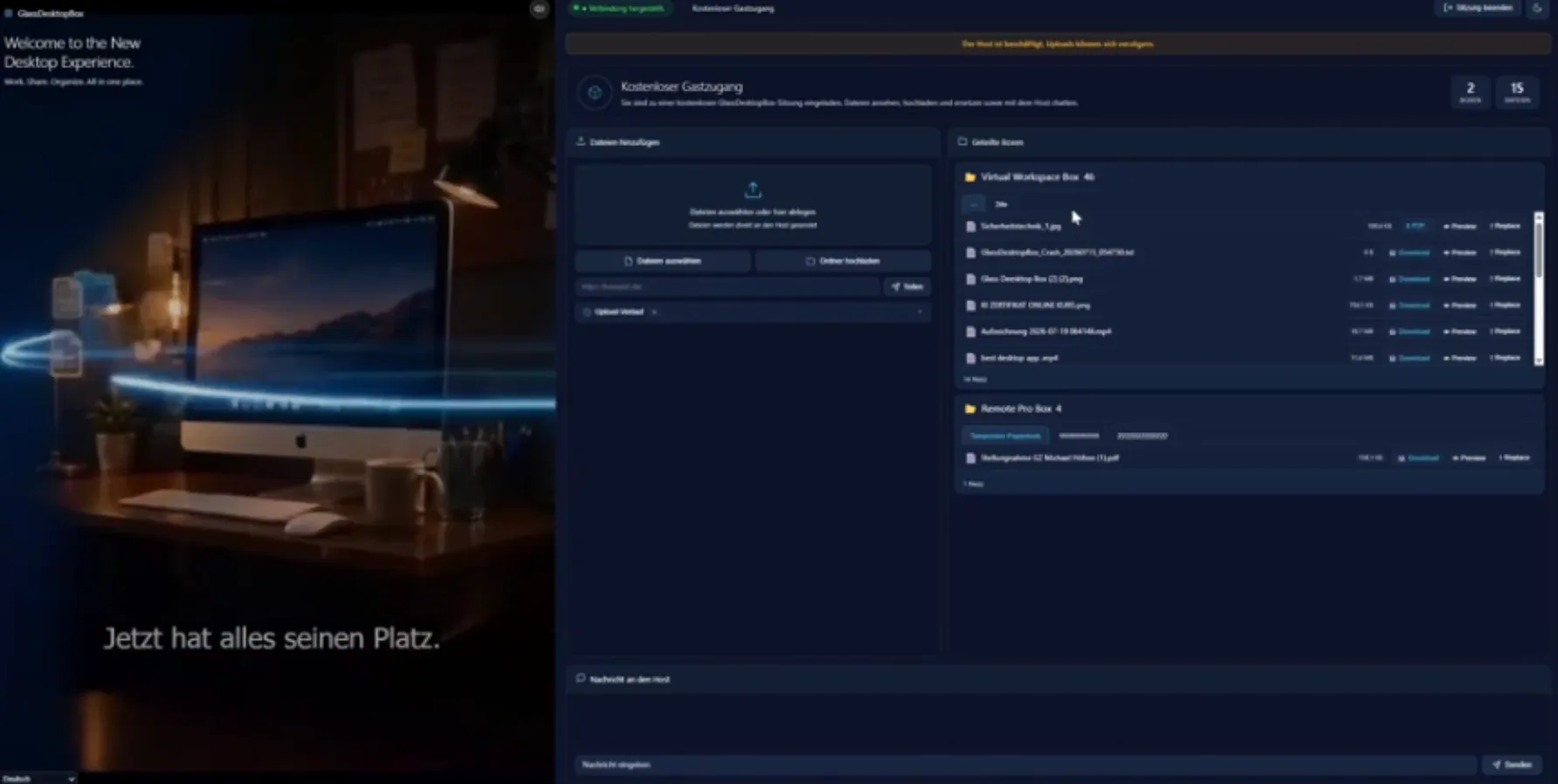
Read video description
The silent demonstration creates a Remote invitation link, shares the PIN with a recipient and opens the browser-based transfer workflow. Files use a direct peer-to-peer route whenever technically possible.
Instant File Sharing
Sharing has never been easier.
Create a Remote invitation link, let the recipient connect through the browser and transfer selected files directly whenever technically possible—without mandatory permanent cloud file storage.
Files travel directly between computers whenever possible—fast, private and without an unnecessary middleman.
Send an invitation link and PIN. Your partner joins through HTTPS without registration or a separate account.
Share approved files, links and chat with customers, colleagues, friends or family from one temporary Remote Desktop Box.
Pro & Pro Duo
Remote ProBox live collaboration

Read video description
The silent demonstration connects two computers to the same Remote ProBox. Both participants work with the shared files and workspace structure while collaboration updates remain synchronized.
Remote Collaboration
One workspace. Two computers.
Work together inside the same Remote ProBox™ in real time. Share files, Selection Tabs, notes and chat while both participants continue working on their own desktops.
Both users see the same project context, with workspace changes synchronized during the active connection.
Built for freelancers, agencies, professional partners and distributed teams working with shared deliverables.
Transfer status, verification and recovery functions help make shared file work understandable and controlled.
P2P Sharing Support
Frequently asked questions.
Answers for invitations, browser sharing, direct connections, Remote ProBox and troubleshooting.
What does P2P mean in Glass Desktop Box?
Peer-to-peer means that files are transferred directly between the participating computers whenever a direct connection can be established. The invitation and connection setup are coordinated securely, but permanent cloud file storage is not required.
Which editions include P2P sharing?
Starter and Plus support Remote invitation links for browser-based guest sharing. Pro and Pro Duo additionally include Remote ProBox for a continuing shared workspace between two installed applications.
How does sharing work in Starter and Plus?
The host creates a Remote invitation link and PIN. The guest opens the link in a modern browser, enters the required access information and can exchange approved files, links and chat messages through the Remote Desktop Box.
Does the guest need to install Glass Desktop Box?
For Starter and Plus browser sharing, the guest normally uses the HTTPS invitation page and does not need the desktop application. Remote ProBox collaboration requires a compatible Glass Desktop Box installation and the appropriate edition.
What is the difference between HTTPS and P2P?
HTTPS describes the secure browser connection and invitation experience. P2P describes the preferred direct transport path between the two computers. They are complementary rather than competing features.
Are files stored permanently in the cloud?
Glass Desktop Box is designed to transfer files without mandatory permanent cloud file storage. Temporary technical processing may be required for connection establishment, security and reliable delivery depending on the connection path.
What happens when a direct P2P connection cannot be established?
The application can use a secured fallback transport so the session remains usable. The available route depends on both networks, firewalls, NAT configuration and the current service environment.
Why can transfer speed differ between sessions?
Performance depends on the slower participant’s upload or download connection, Wi-Fi quality, latency, firewall and NAT behavior, antivirus scanning, storage speed and whether the transfer uses a direct or fallback route.
What transfer speed can I expect with a direct P2P connection?
A direct P2P transfer is primarily limited by the sender’s upload speed, the receiver’s download speed and the slower of the two computers. Protocol overhead, encryption, integrity verification, storage and security software reduce the usable rate slightly. Glass Desktop Box cannot make a 10 Mbit/s upload behave like a 100 Mbit/s upload, but a stable direct route should use the available connection efficiently.
How long should 100 MB or 1 GB take?
Divide the file size by the displayed transfer rate. At 10 MB/s, 100 MB takes about 10 seconds and 1 GB about 1 minute 42 seconds. At 20 MB/s, the same transfers take about 5 seconds and 51 seconds. At 40 MB/s, they take roughly 3 seconds and 26 seconds. Connection setup and final SHA-256 verification can add a short amount of time.
What is the difference between Mbit/s and MB/s?
Internet providers usually advertise megabits per second, written Mbit/s or Mbps. File-transfer displays often use megabytes per second, written MB/s. Eight bits equal one byte, so a 100 Mbit/s upload has a theoretical maximum of about 12.5 MB/s before network overhead.
Why can a transfer wait before the progress bar starts?
Before file data moves, the session may need to negotiate a direct route, traverse NAT and firewall rules, exchange metadata, reserve the destination file, perform security checks and prepare verification. This setup should normally be brief. A long repeated delay can indicate unstable connectivity, blocked direct P2P traffic, security scanning or a stale session.
Why can Host-to-Guest be faster than Guest-to-Host?
Home and business connections are often asymmetric. One participant may have fast download but much slower upload, and Wi-Fi, antivirus or storage performance may differ on each computer. Because reversing the direction also reverses which upload connection is used, the two directions can have noticeably different speeds.
Does every transfer use direct P2P?
Direct P2P is the preferred route whenever both networks permit it. The product goal is to keep the large majority of eligible transfers direct, but NAT types, corporate firewalls, carrier-grade NAT, VPNs and restricted networks can prevent a direct connection. In that situation a secured fallback route may be required so sharing remains available.
Why is a fallback transfer usually slower?
A direct transfer travels between the two computers. A fallback path introduces an additional network hop and is also limited by the relay route, distance, congestion and both participants’ connections. It prioritizes reliable delivery when a direct connection is not possible, but it may not match direct P2P performance.
Why can a transfer restart, pause or appear to repeat?
Typical causes include a connection change, sleeping computer, unstable Wi-Fi, interrupted session, outdated application version, integrity mismatch or failure to confirm the final block. Both participants should use the same current version. Repeated restarts of the same file are not normal and should be reported with the file size, direction, displayed route, application versions and approximate time.
Can large files be transferred?
Yes. Large-file performance depends on both computers and their network paths. Keep both applications running, avoid unstable Wi-Fi and ensure enough free storage space before starting a large transfer.
What cannot be transferred?
Glass Desktop Box can transfer normal files and supported folder content, but it cannot reliably transfer a file that the sending user cannot read, that has been removed or renamed after selection, or that is exclusively locked by another application. Transfers can also be rejected when the receiver has insufficient storage, lacks permission to write to the destination, the path or filename is invalid on the receiving operating system, or security software blocks the file. Operating-system devices, protected system objects, active application memory, virtual placeholders that have not been downloaded locally and unsupported special filesystem objects are not ordinary transferable files.
Which temporary and technical files are excluded?
Transient files that do not represent a finished user document should not be transferred or synchronized as normal workspace content. This includes temporary and cache files, Office lock files such as names beginning with ~$ , incomplete browser downloads such as .crdownload, .part, .partial or .download, application lock files, transfer fragments, internal journals, recovery working files and operating-system metadata such as Thumbs.db, desktop.ini or .DS_Store. Glass Desktop Box internal staging, verification, recovery and Temporary Recycle Bin data must also remain internal and must not re-enter the shared workspace as a new user file.
Why are temporary files ignored?
Many applications create and repeatedly rewrite temporary files while a document is open. Synchronizing those files can cause unnecessary transfers, duplicate entries, endless change loops or incomplete content. The finished saved document is the relevant file; its technical working files are not.
Can I manually send a file with a temporary extension?
A genuine user file with a normally excluded temporary extension may require renaming before transfer. This prevents an unfinished download, lock file or internal fragment from being mistaken for a completed document. Rename it only after confirming that the source application has finished writing it.
Are executable files and installers allowed?
Installers and executable files may be transferable, but browsers, Windows, antivirus products, company policies or the receiving operating system can warn, quarantine or block them. Glass Desktop Box does not bypass these protections. The recipient should only accept executable content from a trtú sender and verify its publisher and digital signature before opening it.
Can open documents be transferred?
An open document can only be transferred consistently if the application allows it to be read and its latest changes have already been saved. Files that are still being written or exclusively locked may fail or produce an outdated snapshot. Save and close important documents before sending when a consistent final version is required.
Can cloud placeholders and network files be transferred?
A cloud placeholder must first be available as a complete local file. Files on network drives, removable media or synchronized folders can be transferred only while the source remains connected, readable and unchanged. If the source disappears during transfer, delivery cannot complete.
Are there filename or path restrictions?
The destination operating system determines valid characters, reserved names and maximum path behavior. A name that works on one platform may be invalid on another. Glass Desktop Box should report the conflict; rename the affected file or shorten the path before retrying.
Can malware or prohibited content be transferred?
Glass Desktop Box is not intended to bypass antivirus, browser, operating-system, company or legal restrictions. Security software may block or quarantine suspicious content. Users remain responsible for having permission to share a file and for complying with applicable laws, contracts and organizational policies.
What happens if a connection is interrupted?
The interface reports the interrupted connection and any incomplete transfer. A completed file is only treated as successfully delivered after the expected transfer and verification steps have finished.
How do I invite someone securely?
Create a new invitation for the intended session, send the link through a trtú channel and share the PIN only with the intended recipient. Close the Remote Box when the exchange is complete.
What is Remote ProBox?
Remote ProBox is a shared live workspace available with the corresponding Pro editions. Both participants work with the same organized project context while remaining on their own computers.
How is Remote ProBox different from Starter and Plus sharing?
Starter and Plus focus on fast guest exchange through an invitation and browser. Remote ProBox is designed for continuing collaboration, synchronized Selection Tabs, files, notes and chat between two application users.
Do both ProBox participants see the same files?
During an active synchronized session, both participants see the shared workspace content made available through the ProBox. Local security rules and transfer completion still determine when a file is fully available.
Can both participants create Selection Tabs?
Remote ProBox is designed to synchronize the shared workspace structure, including supported Selection Tabs. Changes should appear for both participants while the session is active.
How are changed files protected?
Where the protected replacement workflow applies, the previous version can be moved into the Temporary Recycle Bin before the updated file becomes the active version. Users should verify important work before permanently clearing recovery content.
What should I check when P2P sharing is slow?
Check both internet connections, use Ethernet where possible, close competing uploads, confirm that firewalls allow the application, keep the current version installed on both computers and retry with a newly created session if the connection state is stale.
Where can I get help?
Open the Support and Knowledge Base pages for connection, invitation, firewall and transfer guidance. Include the edition, application version, direction of transfer, file size and observed status when reporting a problem.